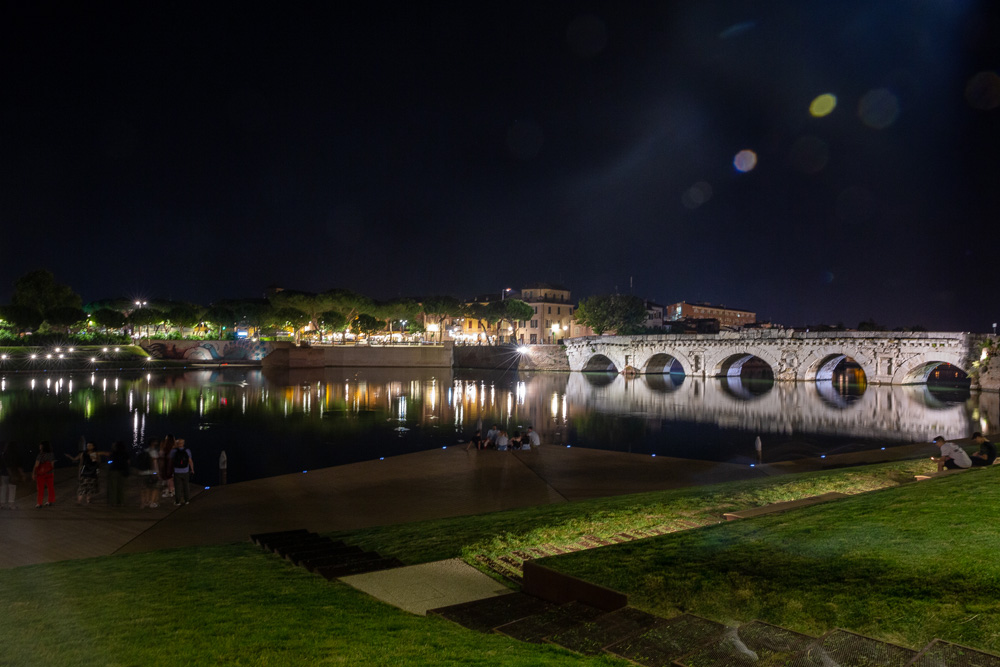
The construction of the Tiberius Bridge over the Ariminus River, now known as the Marecchia River, was begun by Emperor Augustus in 14 AD and completed by Tiberius in 21 AD. Having survived the Greco-Gothic wars in the 6th century A.D. and the bombings of World War II, the bridge, now a pedestrian bridge, connects the old town centre to the picturesque village of San Giuliano.
The Tiberius Bridge is one of the most remarkable Roman bridges that have survived to this day.
Together with the Arch of Augustus, the bridge is one of the fundamental symbols of imperial power in Rimini, with which the inhabitants identified. Even today, the two Roman monuments still form part of the coat of arms of the Municipality of Rimini.
Built out of Istrian stone, it has a structure composed of five round arches with blind aedicules between the imposts of the arches. The width of the arches increases towards the centre, where the largest arch is located. On the edges of the pavement are some stone slabs with Latin inscriptions. The orientation of the supporting piers is oblique to the axis of the bridge, so as to accommodate the river current by reducing its impact force, which is why the bridge has survived 20 centuries unscathed.
Two roads departed from the Tiberius Bridge in ancient times, the Via Emilia that connected Rimini to Piacenza and the Via Popilia that led to Ravenna. It was a fundamental junction of the Rimini Caput Viarum.